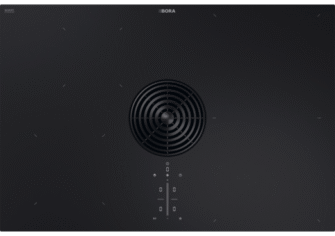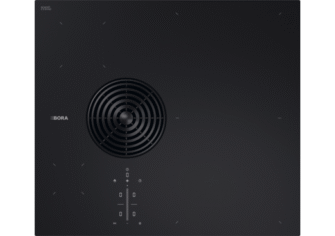

BORA Hob vs Conventional Hob and Cooker Hood
Should you choose a BORA hob with integrated extraction or install a conventional hob with a separate cooker hood? Both arrangements can provide effective cooking and kitchen ventilation, but they have different implications for cabinetry, installation, everyday use and kitchen design.
BORA combines cooking and extraction within one appliance, drawing cooking vapours towards an extractor integrated into the hob surface. This removes the need for a separate overhead cooker hood and can be particularly useful for kitchen islands, open-plan spaces and kitchens where unobstructed sightlines are important.
However, a BORA cooktop extractor requires suitable space beneath the worktop for the appliance and its extraction system. A conventional hob and separate cooker hood may offer more flexibility when replacing existing appliances or designing a kitchen around traditional overhead extraction.
This guide explains the practical differences, including BORA's installation requirements, available cooking systems, ducted and recirculating options, cleaning and the factors to consider before deciding.
How Is a BORA Hob Different from a Conventional Hob and Cooker Hood?
A conventional kitchen arrangement uses a hob for cooking and a separate extractor hood positioned above or near the cooking area. The hob and extraction system can be chosen, installed and replaced independently.
BORA cooktop extractor systems integrate ventilation directly into the cooking surface. Rather than allowing vapours to rise towards a separate hood, the extractor draws air towards an inlet positioned between or alongside the cooking zones.
The principal difference is therefore not necessarily the cooking technology itself, but where extraction takes place and how the kitchen must be planned around it.
What Are the Benefits of Choosing a BORA Hob?
Unobstructed Kitchen Design
One of the main advantages of a BORA cooktop extractor is the absence of a conventional overhead cooker hood.
This can be particularly appealing in kitchen islands, open-plan kitchens and spaces with large windows or uninterrupted views. Cooking and extraction remain integrated at worktop level, without requiring a suspended extractor above the hob.
Extraction Integrated into the Cooking Surface
BORA systems draw cooking vapours towards an integrated extraction inlet. This is designed to capture steam, grease particles and cooking odours close to where they are produced.
Actual extraction performance depends on the model, fan setting, installation and cooking conditions. A correctly specified conventional cooker hood can also provide effective ventilation.
Integrated Controls and Cooking Functions
BORA's compact cooktop extractor systems combine induction cooking and extraction controls within the hob itself.
Selected models use BORA sControl+, a touch-slider system with colour-coded controls for cooking zones, extraction and additional functions. Automatic extractor control adjusts ventilation in response to cooking activity.
Current-generation models may also provide BORA Assist cooking functions and BORA One connectivity. These features vary by model and generation, so check the specification of the chosen appliance.
What Kitchen Space Does a BORA Hob Need?
Unlike a conventional hob and overhead cooker hood, a BORA cooktop extractor requires space beneath the worktop for its extraction components.
BORA's compact Pure-family systems use a low-profile design, but the kitchen unit, worktop cut-out, ventilation route and drawer configuration still need to be planned around the selected appliance.
Different BORA ranges have different minimum kitchen-unit requirements:
| BORA Range | Hob Width | Kitchen Unit | Cooking Layout |
|---|---|---|---|
| S Pure | 580mm | 600mm | Compact four-zone induction |
| Pure | 760mm | 800mm | Four round induction zones |
| M Pure | 760mm | 800mm | Round and bridgeable induction zones |
| X Pure | 830mm | 900mm | Four large surface-induction zones |
These are model-family planning dimensions, not worktop cut-out measurements. Always use the exact BORA installation drawing before finalising cabinetry or ordering a worktop.
Can You Install a BORA Hob Above Kitchen Drawers?
Many BORA systems are designed to retain useful storage beneath the cooking surface. Current Pure-family appliances have an installation height of approximately 199mm, although the complete extraction arrangement may require additional space or cabinet modifications.
Some installations can preserve a practical drawer layout, while others may need changes to the cabinet back panel, drawer depth or plinth to accommodate airflow and extraction components.
The exact arrangement depends on the BORA model and whether ducted or recirculating extraction is chosen.
A conventional hob with a separate overhead extractor may offer greater flexibility beneath the worktop, especially when retaining an existing kitchen layout is the priority.
Does a BORA Hob Need External Ventilation?
No. BORA cooktop extractor systems are available in ducted and recirculating configurations, allowing the extraction method to be selected according to the kitchen.
Ducted BORA Hobs
Ducted models direct extracted cooking air outside through suitable ventilation ducting. This removes extracted cooking moisture and odours from the room, but requires a planned route to an external outlet.
Recirculating BORA Hobs
Recirculating models filter grease and cooking odours before returning the air to the kitchen. This can simplify installation where an external duct route is impractical.
Recirculating systems require appropriate return-air ventilation and periodic replacement of activated-charcoal odour filters. Because moisture remains in the room, adequate kitchen ventilation is still important.
Both configurations are available across the principal BORA Pure-family systems. The correct model should be chosen before installation rather than assuming the extraction type can be changed without additional components or alterations.
How Easy Is a BORA Hob to Clean?
BORA cooktop extractors are designed with removable extraction components accessible from above the cooking surface.
The stainless-steel grease filter and suitable removable components can be cleaned in a dishwasher, subject to the manufacturer's instructions. This makes routine maintenance accessible without dismantling the kitchen cabinetry.
Recirculating models also require activated-charcoal filter replacement. Current Pure-family systems provide access to the appropriate odour filter through the extraction opening.
Both BORA and conventional cooker hood arrangements require regular grease-filter maintenance. The cleaning difference is mainly where the extraction components are positioned and how they are accessed.
Is a BORA Hob Suitable for a Kitchen Island?
A kitchen island is a strong use case for a BORA cooktop extractor because extraction is integrated into the worktop instead of requiring a suspended island cooker hood.
This can preserve clear sightlines and allow lighting or other design features to be positioned above the island.
However, the island must provide suitable space for the appliance, electrical supply, ventilation components and any required ducting. The extraction route should be planned alongside the kitchen-unit and worktop design.
A conventional island hood or ceiling extractor remains an alternative, particularly where existing overhead ventilation is available or storage beneath the island needs to be preserved.
Should You Replace an Existing Hob and Cooker Hood with BORA?
Replacing a conventional hob with a BORA cooktop extractor is possible in many kitchens, but it is not necessarily a straightforward appliance swap.
A BORA system may require a wider or different worktop opening, changes to the base cabinet and a new extraction arrangement. The existing electrical supply must also be suitable for the selected appliance.
For a new kitchen, these requirements can be incorporated into the design from the beginning. For an existing kitchen, the cost and practicality of modifying cabinetry, worktops and ventilation should be assessed before choosing a model.
Is a BORA Hob Worth Choosing Over a Separate Hob and Hood?
A BORA cooktop extractor is worth considering if you want cooking and extraction integrated into one appliance and are planning a kitchen where overhead space, island design or unobstructed views are important.
It is particularly relevant when the cabinetry and ventilation system can be designed around the appliance from the outset.
A conventional hob and separate cooker hood may be more practical when you already have suitable overhead extraction, want to retain storage beneath the worktop or prefer to replace the hob and extractor independently.
Compare the total installed cost rather than the appliance price alone. This should include the hob, extraction equipment, electrical work, ducting or recirculation components, worktop alterations and ongoing filter maintenance.
BORA Hob vs Conventional Hob and Hood FAQs
Do you need a cooker hood with a BORA hob?
No. BORA cooktop extractor systems incorporate extraction into the hob itself, so a separate conventional cooker hood is not normally required. The integrated extractor must still be installed with the correct ducted or recirculating ventilation arrangement.
Does a BORA hob work as well as a conventional extractor?
BORA systems are designed to capture cooking vapours close to the cooking surface. However, extraction performance depends on the specific appliance, cooking conditions and installation. A properly specified overhead cooker hood can also provide effective extraction.
Are BORA hobs quieter than conventional cooker hoods?
Not automatically. Operating noise depends on the individual extractor, fan speed, airflow and installation. Compare published sound-power figures under equivalent conditions rather than assuming either extraction arrangement is quieter.
Can a BORA hob be used without outside ducting?
Yes. BORA recirculating models filter grease and odours before returning air to the room. They require suitable return-air arrangements, activated-charcoal filter maintenance and adequate room ventilation.
Do BORA hobs take up cupboard space?
They require space beneath the worktop for the extraction system, but many BORA models are designed to preserve useful drawer storage. The exact amount depends on the appliance and its installation configuration.
Can you use large pans on a BORA hob?
Yes, but cooking-zone layouts differ. BORA Pure uses four round induction zones, while M Pure and X Pure offer bridgeable surface-induction zones suitable for larger cookware. Check the supported cookware dimensions for each model.
Can a BORA hob replace a standard 60cm induction hob?
BORA S Pure is designed for a 600mm kitchen unit, making it a possible option for some kitchens with restricted space. However, replacing an existing hob still requires checks of the worktop opening, cabinet depth, electrical supply and extraction installation.
Explore BORA Cooking Systems
Browse our BORA Hobs to compare S Pure, Pure, M Pure and X Pure cooktop extractor systems.
For further developments in BORA cooking technology, explore our BORA Innovations guide, including the five-zone X Pure Max.
You can also browse Induction Hobs and Cooker Hoods if you prefer a separate hob and extraction arrangement.