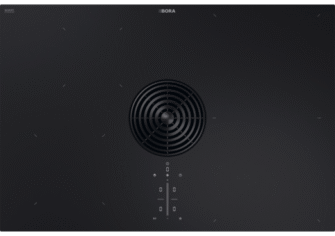

BORA Ducted vs Recirculating Hobs | Which to Choose?
Should you choose a ducted or recirculating BORA hob? Both configurations combine induction cooking with integrated extraction, but the way they manage cooking vapours, moisture and odours is different. Choosing the correct extraction type is an important part of specifying a BORA cooktop extractor for your kitchen.
Ducted BORA hobs discharge extracted cooking air outside through a suitable ventilation system. Recirculating models use grease and activated-charcoal filters before returning the filtered air to the kitchen, removing the need for an external extraction outlet.
BORA Pure, M Pure and X Pure are available in both configurations, with different model codes for each. This guide explains the installation requirements, ventilation considerations, filter maintenance and differences between the available BORA variants.
Compare the BORA ducted and recirculating models below, or explore our complete range of BORA hobs and cooktop extractors.
BORA Ducted vs Recirculating Hobs Compared
The principal difference between the two BORA extraction configurations is what happens to the cooking air after it enters the integrated extractor.
Both use grease filtration and integrated extraction at cooktop level. Ducted models discharge the extracted air outside, while recirculating versions use an additional odour filter before returning air to the room.
| Feature | BORA Ducted | BORA Recirculating |
|---|---|---|
| Extraction method | Discharges cooking air outside | Filters and returns air to the kitchen |
| External ducting | Required | Not required |
| Cooking moisture | Extracted moisture is discharged outside | Moisture remains in the room |
| Grease filtration | Required | Required |
| Activated-charcoal filter | Not normally required | Required for odour filtration |
| Kitchen planning | External duct route and outlet required | Suitable filtered-air return path required |
| Ongoing maintenance | Grease-filter cleaning and duct-system maintenance | Grease-filter cleaning and periodic odour-filter replacement |
| Typical use | Kitchens with a practical external duct route | Kitchens where external extraction is impractical |
Which BORA Model Is Ducted and Which Is Recirculating?
BORA offers dedicated extraction configurations across its Pure-family cooktop extractors. Choosing between ducted and recirculating operation does not necessarily mean choosing a different cooking-zone layout.
For example, BORA Pure is available with four round induction cooking zones in either extraction configuration. BORA M Pure and X Pure also offer corresponding ducted and recirculating variants.
| BORA Range | Ducted Model | Recirculating Model | Hob Width |
|---|---|---|---|
| Pure | PURA2 | PURU2 | 760mm |
| M Pure | PURMA2 | PURMU2 | 760mm |
| X Pure | PUXA2 | PUXU2 | 830mm |
These examples are current-generation high-gloss models. BORA also offers matt-finish variants and other cooktop extractor systems. Check the complete model reference before ordering, particularly where earlier generations remain available.
How Does Ducted Extraction Work on a BORA Hob?
A ducted BORA hob draws cooking vapours through its integrated extractor and channels the extracted air outside through a suitable duct system.
Current Pure-family exhaust-air models use BORA Ecotube ducting connections. The complete installation must be designed around the appliance, available cabinet space, duct route and suitable external outlet.
Ducted extraction removes extracted moisture from the kitchen as well as carrying cooking odours and airborne grease particles towards the outside. It does not normally require an activated-charcoal odour filter.
What Should You Check Before Choosing Ducted BORA Extraction?
Confirm that a suitable route to an external wall, roof or other approved outlet is available. The duct route should be planned to minimise unnecessary restrictions and comply with BORA's installation requirements.
Consider how the extraction components will fit within the base cabinet, including any required adjustments to drawers or cabinet panels.
The building's ventilation arrangement must also be considered, particularly in airtight properties or where combustion appliances are present. Follow the manufacturer's planning instructions and applicable ventilation requirements.
How Does Recirculating Extraction Work on a BORA Hob?
A recirculating BORA hob draws cooking vapours through the integrated extractor, passes the air through grease and odour filtration and returns the filtered air to the kitchen.
This avoids the need for an external extraction outlet, making recirculation particularly useful where routing ductwork outside would be impractical.
However, recirculation still requires careful installation. The filtered air must be able to return to the room through an appropriately designed airflow path within the cabinetry.
Does a Recirculating BORA Hob Need Ventilation?
Yes. Recirculating extraction reduces grease and cooking odours, but it does not remove the moisture produced during cooking from the room.
Adequate kitchen ventilation is therefore still necessary, whether through suitable room ventilation, openable windows or a properly designed mechanical ventilation system.
The recirculating installation must also provide the return-air openings and cabinet clearances specified in the relevant BORA installation drawing.
What Are the Installation Differences Between BORA Ducted and Recirculating Hobs?
The correct extraction configuration should be selected before finalising kitchen cabinetry and worktop dimensions.
Installing a Ducted BORA Hob
Ducted installations require suitable ductwork connecting the extractor to an external outlet. The available routing space, duct components, wall penetration and cabinet modifications all influence installation planning.
Installing a Recirculating BORA Hob
Recirculating installations require appropriate odour filtration and a return-air arrangement within the kitchen cabinetry. Depending on the BORA model and installation system, this may involve openings or modifications to cabinet backs, plinths or other internal components.
Recirculation does not automatically mean that no cabinet modifications are required. The correct installation depends on the selected BORA system and the manufacturer's planning documentation.
Do BORA Recirculating Hobs Need Replacement Filters?
Yes. BORA recirculating hobs use activated-charcoal filters to reduce cooking odours. These filters have a limited service life and require replacement.
For current BORA Pure-family recirculating systems, the specified filter interval is typically 150 operating hours or approximately one year, depending on the filter and usage.
The appliance provides a filter-service indication when replacement is required. On current compact Pure-family systems, the odour filter can be accessed through the extractor opening from above the cooking surface.
Both ducted and recirculating BORA hobs have grease filters that require regular cleaning. Suitable removable components can be washed in a dishwasher according to the manufacturer's instructions.
Can You Convert a BORA Hob from Ducted to Recirculating?
Conversion may be possible for selected BORA systems using the appropriate manufacturer-approved components. However, ducted and recirculating variants are supplied with different extraction arrangements and must not be assumed to be directly interchangeable.
Changing the extraction configuration can require additional filters, air-guiding components, ducting alterations and changes to the kitchen cabinetry.
It is generally preferable to choose the correct configuration during kitchen planning rather than relying on a conversion after installation.
Which BORA Extraction Configuration Is Better for Your Kitchen?
Choose a ducted BORA hob when there is a practical, properly designed external ventilation route and you want extracted cooking moisture discharged outside. This also avoids the regular replacement of activated-charcoal odour filters.
Choose a recirculating BORA hob when external ducting is impractical or conflicts with the kitchen layout. Recirculating systems can offer greater flexibility during kitchen planning, provided adequate return-air and room ventilation are included.
Neither configuration should be selected on the assumption that it will always be quieter, cheaper or easier to install. These factors depend on the appliance, airflow arrangement, cabinet design and installation.
For assistance selecting the correct BORA variant, explore our BORA Hobs range and check the installation requirements for your chosen model.
BORA Ducted vs Recirculating FAQs
Does a BORA hob have to vent outside?
No. BORA cooktop extractor systems are available in recirculating configurations that filter cooking air before returning it to the room. Ducted models require a suitable external extraction route.
Is ducted extraction better than recirculation for a BORA hob?
Ducted extraction removes extracted cooking moisture outside and avoids activated-charcoal filter replacement. Recirculation is more suitable where external ductwork cannot easily be installed. The better option depends on the kitchen and ventilation requirements.
What is the difference between BORA PURA2 and PURU2?
PURA2 is the ducted BORA Pure model, while PURU2 is the recirculating version. Both use the Pure cooking-zone layout, but their extraction and installation arrangements differ.
What is the difference between BORA PURMA2 and PURMU2?
PURMA2 is the ducted M Pure model. PURMU2 is the recirculating equivalent with activated-charcoal odour filtration. Both offer M Pure's combination of round and bridgeable induction cooking zones.
Does BORA recirculation remove steam?
The extractor captures cooking vapours, but moisture is not discharged outside in recirculation mode. The filtered air returns to the kitchen, so adequate room ventilation is still necessary.
How often should BORA recirculation filters be replaced?
Current Pure-family systems generally specify replacement after approximately 150 operating hours or one year, depending on the filter and usage. Follow the appliance's filter-service indication and the manufacturer's instructions.
Are BORA ducted hobs louder than recirculating hobs?
Neither configuration is automatically quieter. Noise depends on the selected model, extractor speed, ducting restrictions, filtration and installation. Compare manufacturer figures for equivalent operating conditions.
Can a BORA recirculating hob be installed in a kitchen island?
Yes, provided the island cabinetry offers the space, electrical supply and return-air arrangement required for the chosen BORA model. The installation should be planned before worktop manufacture.
Explore More BORA Appliances
Browse our BORA Hobs range, including BORA Pure, BORA M Pure and BORA X Pure.
For other BORA cooking and kitchen developments, discover our BORA Innovations guide.