
Smeg Pyrolytic vs Vapor Clean Ovens
What's the difference between Smeg pyrolytic and Vapor Clean ovens? Both are designed to make oven cleaning easier, but they work in very different ways. Pyrolytic cleaning uses extreme heat to reduce baked-on grease and food residue to ash. Vapor Clean uses moisture and a lower-temperature cleaning programme to soften dirt before you wipe the oven manually.
Choose pyrolytic if you want to reduce manual scrubbing, particularly after heavy roasting and grilling. Choose Vapor Clean if you prefer regular, lighter cleaning and don't mind wiping the oven yourself. Neither system determines how the oven cooks, so compare cooking functions, dimensions and capacity as well.
Smeg Pyrolytic vs Vapor Clean: Key Differences
| Feature | Pyrolytic Cleaning | Vapor Clean |
|---|---|---|
| How it works | Uses temperatures approaching 500°C to break down cooking residue | Uses moisture and heat to soften deposits |
| Cleaning result | Residue is reduced to ash, which can be wiped away after cooling | Loosened grease and food deposits must be wiped away manually |
| Manual cleaning required | Relatively little cavity wiping after the cycle | More wiping and occasional additional cleaning |
| Best for | Heavily used ovens and baked-on grease | Regular cleaning and lighter everyday residue |
| Programme temperature | Very high temperature | Lower temperature with steam-assisted cleaning |
| Door during cleaning | Locks during the high-temperature cycle and remains locked until safe | Follow the normal cleaning-programme instructions |
| Preparation | Remove specified accessories and excess loose residue | Add the required water and prepare the cavity as directed |
| Steam cooking included? | Not necessarily | Not necessarily |
The important distinction is automatic high-temperature cleaning versus steam-assisted manual cleaning. Vapor Clean is not the same as the pyrolytic self-cleaning process, and neither cleaning system guarantees a particular range of cooking features.
Which Smeg Oven Cleaning System Should You Choose?
- Choose Pyrolytic if you regularly roast meat, grill food or cook dishes that leave stubborn grease and baked-on residue.
- Choose Vapor Clean if you clean your oven frequently, usually deal with lighter residue and are happy to finish by wiping the cavity.
- Consider cooking functions separately if you want steam-assisted cooking, a combination microwave, a food probe or particular oven programmes.
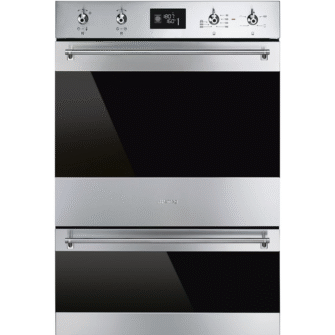
- Check installation requirements before ordering. The range includes conventional 60cm ovens, compact models, wider ovens and double-oven configurations.
Browse the Smeg ovens below to compare cleaning systems, sizes, cooking features and finishes.
How Does Smeg Pyrolytic Cleaning Work?
Smeg pyrolytic ovens have a dedicated self-cleaning programme that raises the cavity temperature to approximately 500°C. At this temperature, accumulated cooking grease and food residue are broken down into a fine ash.
The oven door locks automatically during the cleaning cycle and remains locked until the appliance has cooled sufficiently. Once the cycle has finished and the cavity is cool, the remaining ash can be wiped away with a damp cloth.
Pyrolytic cleaning reduces the need for manual scrubbing, but it does not mean the oven requires no maintenance. Door glass, seals and other areas still need appropriate care.
Before running a pyrolytic cycle, remove accessories and components specified in the manufacturer's instructions, including shelves, trays and telescopic runners where required. Remove excessive loose food residue and follow the recommended safety precautions.
Is Pyrolytic Cleaning Worth It?
Pyrolytic cleaning is particularly useful for households that use their ovens regularly for roasting, grilling and other cooking that produces baked-on grease.
The main benefit is convenience. Rather than repeatedly scrubbing the inside of the oven, you can use the dedicated programme and wipe away the remaining ash after cooling.
However, the high-temperature cycle takes time and uses electricity. You must also wait for the oven to cool before opening the door or returning accessories to the cavity.
How Does Smeg Vapor Clean Work?
Smeg Vapor Clean is a cleaning programme that uses water and heat to create moisture inside the oven cavity. This helps soften grease and food deposits, making them easier to remove with a cloth or sponge.
Unlike pyrolytic cleaning, Vapor Clean does not reduce residue to ash. You still need to wipe the cavity thoroughly, and particularly stubborn or burnt-on marks may require further attention.
Vapor Clean is most effective as part of regular oven maintenance, rather than leaving a heavily soiled cavity for long periods between cleans.
Follow the instructions for the exact oven, including the specified water quantity, programme settings and cleaning procedure. Do not assume that every Smeg Vapor Clean model has identical controls or water-loading requirements.
Is Vapor Clean Worth It?
Vapor Clean can be a practical option if you prefer shorter, routine cleaning sessions and usually remove spills before they become heavily baked on.
It is also worth considering when an oven's cooking functions, design and price meet your needs and you are comfortable doing more manual cleaning than with a pyrolytic model.
However, customers who regularly deal with stubborn roasting residue may prefer the convenience of pyrolytic self-cleaning.
Does Vapor Clean Mean the Oven Can Cook with Steam?
No. This is one of the most important distinctions when comparing Smeg ovens.
Vapor Clean is a cleaning function, not a steam-cooking specification. An ordinary multifunction oven can have Vapor Clean without offering steam-assisted cooking.
Conversely, selected Smeg ovens can cook with steam and still use a pyrolytic cleaning system.
For example, some Smeg SteamOne and Pyro Steam models combine conventional cooking with controlled steam, while their cleaning programmes differ between specific products.
If steam cooking is a priority, check the manufacturer's stated cooking method and steam functions separately from the cleaning system.
What Is Smeg Ever Clean Enamel?
Ever Clean enamel is a special oven-cavity coating designed to reduce the adhesion of grease and food residue, helping to make the internal surfaces easier to maintain.
It is not the same as an automatic pyrolytic cleaning programme.
Smeg uses Ever Clean enamel in ovens with different cleaning systems, including selected Vapor Clean models. Descriptions referring to pyrolytic enamel therefore do not necessarily mean that the oven has pyrolytic self-cleaning.
To identify the actual cleaning function, look for the manufacturer's specified cleaning system rather than relying on the cavity-coating description.
Does Pyrolytic Cleaning Use More Electricity Than Vapor Clean?
Pyrolytic cleaning heats the oven to a much higher temperature than Vapor Clean, so electricity consumption during the cleaning programme is an important consideration.
However, the cost of an individual cleaning cycle depends on the appliance, programme duration and settings, as well as your electricity tariff.
Vapor Clean uses a lower-temperature cleaning process, but it may require more hands-on work and repeated cleaning where food deposits are particularly stubborn.
Do not confuse cleaning-cycle energy use with the oven's published energy efficiency class. The energy label primarily relates to standardised cooking performance, not a direct comparison of cleaning-programme running costs.
Are Pyrolytic Ovens Better at Cooking?
Not automatically. Pyrolytic and Vapor Clean describe how an oven is cleaned, not whether it cooks food more evenly or has more cooking functions.
When comparing Smeg ovens, consider:
- Cooking method: Conventional multifunction, fan-assisted, steam combination or microwave combination.
- Oven capacity: Usable cavity volume in litres and the available shelf positions.
- Installation format: Standard single, compact, double or wider built-in oven.
- Cooking features: Food probes, automatic programmes, steam functions and other model-specific settings.
- Controls: Knobs, digital displays, touch controls and connected functions where available.
- Cleaning system: Pyrolytic or Vapor Clean, verified against the exact model.
- Electrical requirements: Check the manufacturer's connection and installation instructions.
A Vapor Clean oven with the cooking functions you need may be a better purchase than a pyrolytic oven that lacks those functions. The reverse is also true if reducing cleaning effort is your main priority.
Frequently Asked Questions About Smeg Oven Cleaning
Which is better, Smeg pyrolytic or Vapor Clean?
Pyrolytic cleaning is generally more convenient for removing baked-on grease because the high-temperature programme reduces residue to ash. Vapor Clean is suitable for regular lighter cleaning but requires more manual wiping. The better option depends on how you cook and how much cleaning you want to do.
Does a Smeg Vapor Clean oven clean itself?
Not in the same way as a pyrolytic oven. Vapor Clean uses moisture to loosen residue, but you must wipe the cavity afterwards and may need to clean stubborn deposits manually.
Do Smeg pyrolytic ovens really reach 500°C?
Yes. Smeg describes pyrolytic cleaning as a high-temperature process approaching 500°C. The oven door automatically locks during the cleaning cycle for safety.
Can you leave oven shelves inside during pyrolytic cleaning?
Do not assume so. Smeg advises removing specified internal accessories before pyrolytic cleaning, including shelves, trays and guides where required. Check the instructions supplied with the exact oven.
Can a Smeg pyrolytic oven also cook with steam?
Yes. Selected Smeg combination ovens provide steam-assisted cooking alongside pyrolytic cleaning. Cooking functions and cleaning systems should be checked separately.
Does Smeg Ever Clean enamel mean the oven is pyrolytic?
No. Ever Clean is a cavity coating, not proof that the appliance has an automatic pyrolytic programme. Smeg also uses it on ovens with Vapor Clean.
Does pyrolytic cleaning replace all manual oven cleaning?
No. It substantially reduces manual cleaning of the cavity, but residue must still be wiped away after the oven cools. Door glass, seals and removable accessories also require appropriate maintenance.
Should I choose an oven based on its cleaning system?
Cleaning is an important consideration, but also compare oven size, cooking functions, capacity, controls and installation requirements. The most suitable appliance should meet your cooking needs as well as your cleaning preferences.
Explore More Smeg Ovens and Cooking Appliances
Browse our complete Smeg Ovens collection to compare built-in single ovens, double ovens, combination steam ovens and other cooking technologies.
For the wider brand range, visit Smeg Appliances, or explore Built-In Ovens from other manufacturers.