
Gas vs Induction Hobs: Which Is Better?
Choosing between gas and induction hobs comes down to how you cook, the appliances your kitchen can accommodate and the type of control you prefer. Gas gives you a visible flame and works with a broad range of cookware. Induction heats compatible pans directly, offering rapid heating, responsive adjustments and an easy-clean glass surface.
Both technologies have advantages. This guide compares gas and induction hobs across cooking performance, running costs, safety, installation and everyday practicality.
Gas vs Induction Hobs: Key Differences
| Feature | Gas Hobs | Induction Hobs |
|---|---|---|
| Heating method | Gas flame heats cookware | Electromagnetic technology heats compatible cookware directly |
| Heat control | Visible flame with rotary controls | Responsive power settings, usually touch-controlled |
| Cooking speed | Generally slower to boil water | Generally faster, especially with boost functions |
| Cleaning | Burners and pan supports require cleaning | Flat glass surface is easier to wipe |
| Cookware | Works with most suitable hob cookware | Requires induction-compatible magnetic bases |
| Installation | Suitable gas supply and safe connection required | Suitable electrical circuit and connected load required |
Is Gas or Induction Better for Cooking?
Gas hobs offer a visible flame, making it easy to judge changes in heat output. They are particularly useful if you prefer traditional rotary controls or regularly use a round-bottomed wok with a suitable burner and support.
Induction hobs respond quickly to power changes and usually heat water faster. Selected models include flexible cooking areas for larger pans, automatic boiling sensors and extra-power settings for rapid heating.
Neither technology guarantees better results for every dish. Cooking performance also depends on the individual hob, cookware and how the heating zones distribute heat.
Which Is Cheaper to Run: Gas or Induction?
Induction is generally more energy efficient because more of the energy is transferred into the cookware rather than lost around the sides of the pan. However, gas can still cost less to run because the price per unit of gas is usually lower than electricity.
Actual running costs depend on your energy tariff, cooking habits, cookware and the efficiency of the appliance. Consider installation and potential electrical upgrades as well as ongoing energy costs.
Which Hob Is Easier to Clean and Safer?
Induction hobs have a smooth glass cooking surface without traditional burners or removable pan supports. This generally makes everyday cleaning easier. The glass can still become hot through contact with cookware, so residual heat warnings remain important.
Gas hobs require cleaning around the burners and pan supports. Many contemporary models include flame-failure protection that stops the gas supply if a flame goes out. Effective kitchen ventilation is also important when cooking with gas.
Should You Switch from Gas to Induction?
Before changing from gas to induction, check whether your existing pans have induction-compatible bases. A magnet that holds firmly to a pan base is a useful initial compatibility test.
You will also need to confirm whether the electrical supply can support your chosen hob. Many larger induction models require a dedicated hardwired circuit. Any redundant gas connection must be dealt with safely by a Gas Safe registered engineer.
Check the manufacturer's worktop cut-out, ventilation clearances and connected load rather than assuming that two nominally 60cm hobs are interchangeable.
Which Gas Hob Should You Choose?
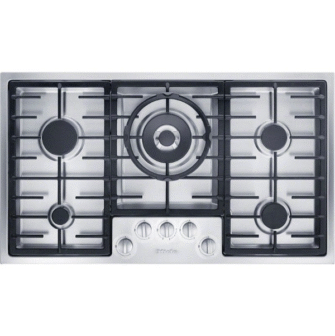
A 60cm four-burner gas hob is suitable for many everyday kitchens. Look at burner arrangement, the presence of a wok burner, pan-support design and flame-control functions.
Wider five-burner models offer additional pan space and may be better suited to households that frequently prepare several dishes together.
Which Induction Hob Should You Choose?
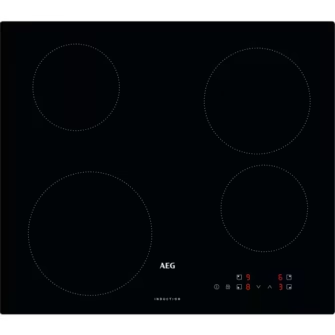
For a typical kitchen, a 60cm four-zone induction hob is a practical starting point. PowerBoost functions are useful for rapid heating, while bridge or flexible zones help accommodate longer pans and larger cookware.
Wider induction models can offer more room for simultaneous cooking. Check the number of independently usable zones, control layout, connected electrical load and installation dimensions.
Can You Have Gas and Induction Together?
Yes. Mixed-fuel hobs combine traditional gas burners and induction zones in a single appliance. They are worth considering if you want the speed and easy cleaning of induction while retaining a flame for particular cooking techniques.
For example, the AEG HDB95623NB mixed gas and induction hob combines two gas burners with three induction zones. It requires suitable gas and electrical connections.
Gas vs Induction Hobs: Frequently Asked Questions
Is induction better than gas?
Induction is generally better for heating speed, energy efficiency and easy cleaning. Gas may be preferable if you want a visible flame, rotary controls or traditional wok cooking.
Are induction hobs cheaper to run than gas?
Not necessarily. Although induction uses energy more efficiently, electricity usually costs more per unit than gas. Your actual costs depend on your tariff and how you cook.
Can I replace a gas hob with an induction hob?
Often, yes. You must check the electrical circuit, worktop dimensions, cookware compatibility and safe disconnection of the existing gas supply.
Do professional cooks prefer gas or induction?
Preferences vary. Some cooks favour the direct flame and familiar controls of gas, while others prefer induction for fast heating and repeatable power adjustments.
Do induction hobs need special pans?
Yes. Induction requires cookware with a suitable magnetic base. Many stainless-steel and cast-iron pans are compatible, but not every pan is suitable.
Is a gas and induction combination hob worth considering?
A mixed-fuel hob is useful if you want both cooking methods. Check its width, pan layout, electrical requirements and gas connection before choosing one.
Explore More Hobs
Compare our full range of hobs, including gas hobs and induction hobs.